The topic of today's blog is not so much portfolio control as it is self control!
No one else knows better than you!
If you haven't already, you'll find out soon that when it comes down to talking about the market, especially stocks, everyone is an expert.... everyone has an opinion that they are more than willing to feed you.
Some will tell you that they think the market is going for a crash, some will tell you its going through the roof, some will give you stock tips and 100 reasons why its sure to make you money. The sad part is that the human mind with all its complexities is a vulnerable emotional mushy machine! Add the potential for making money into the future and you have a potential for disaster. When it comes to trading, you are the only one who knows best. Take it from a guy who's made all the mistakes there is to make when he started out trading.
There are people who know what they are talking about and their views will be profitable, but more than 80% of time they will lose you money. What is worst is not that you lost money, but that you let someone influence you and didn't make the decision on your own.
So, stay away from stock tips. Or at least do your own research on what you've heard.
As a side note, what I've found to be very interesting is that people's advice is governed by their own confirmation behavior. This is a very strong human emotion. The people who will tell you the market is going up, have accumulated long positions. The ones that will tell you the market is going down, have short positions. Their advice is their own rationalization of their positions.
Showing posts with label Educational. Show all posts
Showing posts with label Educational. Show all posts
Wednesday, April 21, 2010


Tuesday, April 6, 2010
April 6 - Portfolio Control - Part 2
Hi all... hope you've had a great Easter long weekend.... I know I did!
I've had a lot of great feedback from the last "Portfolio Control" post. Hopefully you've all had time to think about how important position sizing is to your trading and trading account. It is actually considered to be one of the main pillars of trading. There are more, some of which I will discuss in this post.
Don't Let a Trade Become an Investment
One rookie mistake that I must admit I'm very guilty of committing is rationalizing your trade as an investment when it doesn't work out. Let's say that you bought some shares in Advanced Micro Devices (AMD) because you thought it was a good short-term trade, but it didn't go your way and the stock fell. If you've had a predetermined stop-loss price it should remain there and you should get out when and if its hit. But what many beginner traders do is that they rationalize that AMD is a good company anyway and bound to go up eventually so maybe I will keep this for the long term.... it will go up.
This will ruin your account in the long-term, because its not good trading. Those positions pile up in your account, you lose track and they may very well end up going the way you want, but all the same they might go against you more and more everyday. When you finally close it, it will have eaten into way too much of your hard earned profits.
A very important trading rule, and one that I still need to remind myself from time to time is NOT to let a trade become an "investment."
I've had a lot of great feedback from the last "Portfolio Control" post. Hopefully you've all had time to think about how important position sizing is to your trading and trading account. It is actually considered to be one of the main pillars of trading. There are more, some of which I will discuss in this post.
Don't Let a Trade Become an Investment
One rookie mistake that I must admit I'm very guilty of committing is rationalizing your trade as an investment when it doesn't work out. Let's say that you bought some shares in Advanced Micro Devices (AMD) because you thought it was a good short-term trade, but it didn't go your way and the stock fell. If you've had a predetermined stop-loss price it should remain there and you should get out when and if its hit. But what many beginner traders do is that they rationalize that AMD is a good company anyway and bound to go up eventually so maybe I will keep this for the long term.... it will go up.
This will ruin your account in the long-term, because its not good trading. Those positions pile up in your account, you lose track and they may very well end up going the way you want, but all the same they might go against you more and more everyday. When you finally close it, it will have eaten into way too much of your hard earned profits.
A very important trading rule, and one that I still need to remind myself from time to time is NOT to let a trade become an "investment."
Wednesday, March 31, 2010
March 29 - Portfolio Control
Whenever someone hears of my trading the first question they ask is..... "what's a good stock for me to trade?"
Based on this risk limit, you can size your positions. There are many different ways to calculate position sizing. I will discuss one here. The formula for the number of shares you want to buy is:

1
A lot of people see trading as the buying and selling of stocks; pick the right stock and you make money. In fact there is much more involved... so much more!
Picking the right stock/option/commodity to trade is not even half the battle. Aside from the main buying and selling side of trading, there is another part..... not as sexy as the thrill of buying and selling and seeing the profit appear in your account, but this hidden side of trading makes sure that your account doesn't get out of control and that the money stays in your account.
This other hidden side is the portfolio control. It consists of many things, one of which is position sizing. This means if you have $100k in your account, you don't put $70k into a Google trade just because you think it will go your way. The risk on any trade should be in the range of 1-3% of your total account. This assures that if the market should go against you, and the trade ends up in a loss it does not put a big dent in your account (or ego) and you can go on again.
Based on this risk limit, you can size your positions. There are many different ways to calculate position sizing. I will discuss one here. The formula for the number of shares you want to buy is:
# of shares = risk $ / (swing price average/2)
, where,
# of shares - is rounded down to nearest 100 shares
risk $ - is your amount of cash at risk (for a 3% risk in a $100k account, this is $3,000)swing price average - is the approximate swing in price you expect from the stock
The swing price average depends on what kind of trader you are and what kind of trade you're taking, if you plan to close out position within the day, the week, or possible hold for a long trade.
Let's say that you want to go long on AAPL, and let's also say that this is not a day trade and you've spotted a longer term-trade that you expect to work out in the range of a couple of weeks. To determine the average daily swing that you should think about, you want to calculate the 2-week or 14-day Average True Range of that stock. Stockcharts calculates and plots this for you.
The 14-day ATR is around $4, which indicates an average daily movement of $4/day. The ATR is not constant, it chances as the daily prices become more or less volatile. You can see that back in early February the range was as $6. During the volatile days of 2008/09 this range had gone up to $15/day. But it is a good measure of recent prices changes.
Based on this information, a good position size would be:
size = $3000 / ($4 * 2) = 375
since we don't want to buy in odd lots, we round this down to 300 shares. This ensures that your position can endure the ups and downs associated with normal daily volatility within this stock and you don't hit your risk limit prematurely. Be careful of news heavy days, for a short-term position the ATR may not be a good judge of what a price swing may look like on a news heavy day.... for example AAPL could move way more than $4 on a news heavy day like earning release day.
More on portfolio control to come....
Tuesday, March 16, 2010
March 16 - Life and Trading Lessons from BLACKBERRY POKER!!!!!
This post might seem a little "out there" at first, but read on, there is a serious lesson about life and trading in here!
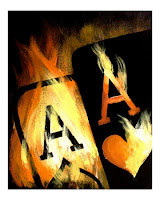 The Game:
I've been playing around with the poker app on my blackberry and recently I've been playing it more often - whenever I have some time to waste; on the subway, waiting at the doctors office, etc.
For those not familiar with the poker app, it's just a computerized no-limit texas holdem poker with 5 players where you start the app with $500 in the bank and play others with the same amount in their starting bankroll. If you keep winning and taking other people's money then you keep going to the higher stakes tables where the blinds go up and people have more money. If at any point lose all your money or go "all-in" and lose then you're OUT! You must restart the game and start with $500 again playing people with the same bankroll.
I should also mention that as other people go all in and lose, they are replaced with new players with a starting bankroll; so the money staying at the table keeps growing.
The Pattern:
At first you keep betting, you may win a couple of hands and lose a couple, but almost everyone has the same amount of money and if you go ALL-IN on a perceived good hand and someone is better then you lose everything and must start again. So you can imagine that at the beginning you will be OUT many times and must start over before building a big enough bankroll which is significantly higher than the other player. This way you can go ALL-IN more often and take bigger risks because even if you lose the hand you have enough to keep going.
Eventually after having gone bankrupt and having to restart I built a huge bank roll...... about $1 million!!! At this point, I dominate. Even if I'm not playing well and lose many hands I can recover by winning big on one large hand and keep going and eventually through enough hands I bankrupt all the other players and win with a massive bankroll.
The Trading Lesson - Capital is King
The dynamics of the game were very different when I had just $500 and to when I had $1 million. This is directly analogous to trading, if you start under capitalized you cannot take risks, and without risk there is no major return. But if you take major risks you may lose all your capital upfront and go bankrupt. But unlike blackberry poker, starting up again may not be so easy as it requires more hard-earned money, not to mention that the discouragement from the last loss effects your decisions!
In the poker game I went bankrupt over 30 times and had to start again with $500 before getting big enough to take more risks and work my way to $1 million. BUT when I had the big bankroll, I didn't have to play as skillfully as I had before, and I could risk more, which ultimately led to more money. It is the same in trading! It is very discouraging at first, especially if you start with little capital. That is why my advice is NOT to start under-capitalized. With an under capitalized account, if you can't take risks. With risk comes return, but also possibility of loss and your account should be able to handle a big string of losses should it occur. That is why.... Capital is KING!!!
As a side thought, with $500 in your pocket would you sit at a poker table where there were 2 players with $1 million bankroll and 3 others with $5 million??? The trading game is the same as the poker table, but you cannot see the other plays or their chips!! Institutional players have virtually UNLIMITED funds compared to small retail accounts. The barriers to getting ahead are high!!! This is not to discourage you, but to shed some light on the situation so we can play smarter.
The Life Lesson - Why the Rich Get Richer
As I pondered the trading lesson, I noticed the bigger lesson in life... "Why do the rich get richer?" Well there are many reasons, but without getting into all of them I think the same principle is at work here. With bigger money comes the ability to take bigger risks. Many big investors make big mistakes but still come out on top.... Look at Donald Trump!! This is because enough capital is there to risk many times over and the losses don't put a big dent in their overall investment capital. Eventually the right risk will earn a return many times higher than the sum of all the previous losses.
With this I leave you with some food for thought
If you had $100k how would you play it? Safe? Risky? Diversified???
Think about this: if you had the chance to invest $10,000 into 10 securities that were risky and each independently could give you 10 times your money or zero. Would go with this? Or think of it as gambling and choose a mutual fund with gradual long-term minimal returns?
 The Game:
I've been playing around with the poker app on my blackberry and recently I've been playing it more often - whenever I have some time to waste; on the subway, waiting at the doctors office, etc.
For those not familiar with the poker app, it's just a computerized no-limit texas holdem poker with 5 players where you start the app with $500 in the bank and play others with the same amount in their starting bankroll. If you keep winning and taking other people's money then you keep going to the higher stakes tables where the blinds go up and people have more money. If at any point lose all your money or go "all-in" and lose then you're OUT! You must restart the game and start with $500 again playing people with the same bankroll.
I should also mention that as other people go all in and lose, they are replaced with new players with a starting bankroll; so the money staying at the table keeps growing.
The Pattern:
At first you keep betting, you may win a couple of hands and lose a couple, but almost everyone has the same amount of money and if you go ALL-IN on a perceived good hand and someone is better then you lose everything and must start again. So you can imagine that at the beginning you will be OUT many times and must start over before building a big enough bankroll which is significantly higher than the other player. This way you can go ALL-IN more often and take bigger risks because even if you lose the hand you have enough to keep going.
Eventually after having gone bankrupt and having to restart I built a huge bank roll...... about $1 million!!! At this point, I dominate. Even if I'm not playing well and lose many hands I can recover by winning big on one large hand and keep going and eventually through enough hands I bankrupt all the other players and win with a massive bankroll.
The Trading Lesson - Capital is King
The dynamics of the game were very different when I had just $500 and to when I had $1 million. This is directly analogous to trading, if you start under capitalized you cannot take risks, and without risk there is no major return. But if you take major risks you may lose all your capital upfront and go bankrupt. But unlike blackberry poker, starting up again may not be so easy as it requires more hard-earned money, not to mention that the discouragement from the last loss effects your decisions!
In the poker game I went bankrupt over 30 times and had to start again with $500 before getting big enough to take more risks and work my way to $1 million. BUT when I had the big bankroll, I didn't have to play as skillfully as I had before, and I could risk more, which ultimately led to more money. It is the same in trading! It is very discouraging at first, especially if you start with little capital. That is why my advice is NOT to start under-capitalized. With an under capitalized account, if you can't take risks. With risk comes return, but also possibility of loss and your account should be able to handle a big string of losses should it occur. That is why.... Capital is KING!!!
As a side thought, with $500 in your pocket would you sit at a poker table where there were 2 players with $1 million bankroll and 3 others with $5 million??? The trading game is the same as the poker table, but you cannot see the other plays or their chips!! Institutional players have virtually UNLIMITED funds compared to small retail accounts. The barriers to getting ahead are high!!! This is not to discourage you, but to shed some light on the situation so we can play smarter.
The Life Lesson - Why the Rich Get Richer
As I pondered the trading lesson, I noticed the bigger lesson in life... "Why do the rich get richer?" Well there are many reasons, but without getting into all of them I think the same principle is at work here. With bigger money comes the ability to take bigger risks. Many big investors make big mistakes but still come out on top.... Look at Donald Trump!! This is because enough capital is there to risk many times over and the losses don't put a big dent in their overall investment capital. Eventually the right risk will earn a return many times higher than the sum of all the previous losses.
With this I leave you with some food for thought
If you had $100k how would you play it? Safe? Risky? Diversified???
Think about this: if you had the chance to invest $10,000 into 10 securities that were risky and each independently could give you 10 times your money or zero. Would go with this? Or think of it as gambling and choose a mutual fund with gradual long-term minimal returns?
Thursday, June 18, 2009
June 18, 2009 - Tricks of the Trade! - part 1
This post is dedicated to a trick you may not find in any trading book. It applies to all trading but it is especially meaningful when day-trading.
It's a common saying that you should "put emotions aside" when trading. Well if it was that easy to turn off your emotions then everyone would be making millions. With experience it becomes a little easier to "see through" your emotions to what your ultimate goal is, but you will never be able to trade without those feelings of fear and greed sneaking back into your mind and affecting your trade. What we can do is not put ourselves in situations when strong emotions can be formed.
Don't Consecutively Trade Anything
Let me explain by way of an example. A new trader, let's call him John, will find what he thinks is a good trading setup and puts in the trade. Shortly after the trade goes against him and he is stopped out at a small loss. At this point in time, feelings are created in John. Feelings of loss and disappointment! He will feel especially attached to this stock so he continues to watch it even after he is stopped out.
John believes that the setup was right for the trade and he must have put his stop-loss in the wrong spot. At this point something interesting happens - the stock goes back up as if to continue the trend that John had predicted. Fear of missing the trade is now strong. John is convinced he was right and gets back in the trade, in hopes of making back the money he just lost and then some. He may even increase the size of the trade to get his money back faster - big mistake!
Unfortunately, the markets punish traders the harshest when they are desperate. John watches the trade turn against him again as if there was someone on the other side manipulating the price against his trade. Fearing bigger losses and doubting the trade ever worked, he gets out - now with a loss wider than the original. This creates even deeper feelings which resemble the feeling of trying recklessly to get your money back at the casino table. Nothing can be more dangerous to a trader's account!
It is human nature to feel greed, fear, and hope. We cannot control them, but we can avoid situations where strong emotions cloud our judgment.
I can say that I've been burned many times trading a losing position in hopes of turning it back into profits. As a result, this is now one of my trading rules: Do not consecutively trade any stock. Once you're out of a trade, do not put in a second trade, unless this was exactly part of your original trading plan. Let yourself cool down and the feels to dissipate before you trade that stock again. This often means not trading that stock again for the day.
Happy trading!
It's a common saying that you should "put emotions aside" when trading. Well if it was that easy to turn off your emotions then everyone would be making millions. With experience it becomes a little easier to "see through" your emotions to what your ultimate goal is, but you will never be able to trade without those feelings of fear and greed sneaking back into your mind and affecting your trade. What we can do is not put ourselves in situations when strong emotions can be formed.
Don't Consecutively Trade Anything
Let me explain by way of an example. A new trader, let's call him John, will find what he thinks is a good trading setup and puts in the trade. Shortly after the trade goes against him and he is stopped out at a small loss. At this point in time, feelings are created in John. Feelings of loss and disappointment! He will feel especially attached to this stock so he continues to watch it even after he is stopped out.
John believes that the setup was right for the trade and he must have put his stop-loss in the wrong spot. At this point something interesting happens - the stock goes back up as if to continue the trend that John had predicted. Fear of missing the trade is now strong. John is convinced he was right and gets back in the trade, in hopes of making back the money he just lost and then some. He may even increase the size of the trade to get his money back faster - big mistake!
Unfortunately, the markets punish traders the harshest when they are desperate. John watches the trade turn against him again as if there was someone on the other side manipulating the price against his trade. Fearing bigger losses and doubting the trade ever worked, he gets out - now with a loss wider than the original. This creates even deeper feelings which resemble the feeling of trying recklessly to get your money back at the casino table. Nothing can be more dangerous to a trader's account!
It is human nature to feel greed, fear, and hope. We cannot control them, but we can avoid situations where strong emotions cloud our judgment.
I can say that I've been burned many times trading a losing position in hopes of turning it back into profits. As a result, this is now one of my trading rules: Do not consecutively trade any stock. Once you're out of a trade, do not put in a second trade, unless this was exactly part of your original trading plan. Let yourself cool down and the feels to dissipate before you trade that stock again. This often means not trading that stock again for the day.
Happy trading!
Subscribe to:
Posts (Atom)