I recently finished reading a book about swindlers and con artists, but not in the way that you might think. This book talks about how the financial auditors and corporate management basically have their hand in the same pie, and the ultimate price is paid by the simple, average investor.
This is the book, and I highly recommend it:
Although this book focuses on the vulnerability of the Canadian Market, I think it's a good general read for anyone who wants to know more about the different schemes in the market, for example, there are example of different kinds of Ponzi schemes, financial trickery and other methods used by corporate executives to get paid at the expense of the average investor.
Swindlers talks a bit about how the Canadian market has become a great place for these scams because of the lack of prosecuting power as well as non-conflicted regulating bodies. There is some focus on how the public mining companies listed in Canada exploit the loop holes for their benefit.
I would say that the book reads kinda boring at times, with repeating evidence of how the introduction of the International Financial Reporting Standards (IFRS) is going to allow more loopholes into the system. But there are some very valid points that I don't think I would have read anywhere else.... the media certainly doesn't talk about this stuff!!
Saturday, February 26, 2011


Wednesday, February 9, 2011
Why equity analysts are Wallstreet goons!
First off, my apologies to my equity analyst friends... This is not personal, it's business!
You know these guys when you hear a headliner on CNBC or Bloomberg, like "Goldman Sachs downgrades RIMM from Buy to Hold", or "Morgan Stanley upgrades Google from underweight to neutral." Now, where's the conflict?
1. We believe these analysts have a duty to report a fair analysis to the public and investors. (fair is by itself vague)
2. These analysts work for banks and these banks own positions in stocks.
3. Banks pay the analysts' salaries and bonuses, not the public!
Who do they work for? Whose interests would they be likely to protect?
So, when an analyst upgrades a stock, don't put in a market order and blindly buy it! Same goes for a downgrade, don't just sell it! What's happening here is actually counter intuitive. The banks aren't in the business of making money for the public, they make money for themselves! And they do make it, at the average investors' expense.
Just as an example, On Oct 28, 2010 Oppenheimer downgrades RIMM from Outperform to Perform, and on Nov 30, 2010 Jefferies, upgrades RIMM from Hold to Buy! Two firms, with essentially similar valuation models for stocks see the need to go opposite ways on the outlook for RIMM. (I'm simplifying, there's more that goes into it.)
Now what's the point of all this? Remember my post from a couple weeks ago on why stocks go up or down? Here's the link (Why Do Stocks Go Up). Read it to understand this situation better!
This basically says that there are only a certain number of buyers or sellers in the market at certain prices, so big volume selling from someone will drop the price because there aren't enough buyers (at the current prices) in the market. Now let's say that Goldman Sachs has big a position in RIMM, (and I don't mean 1000 shares, I mean 500,000 shares or more) and they feel that the medium-term future is not so good.... and they don't wanna be left holding the bag when the bad news hits... SO, the analyst steps in with an upgrade based on some bullshit qualitative reason that no one will remember a week from then. The news of the upgrade hits Bloomberg TV, CNBC, and other news wires. The average investor looks at this as a positive sign and decides to get in.... Call broker, or login to online account, hit BUY RIMM @ MARKET.... after all if Goldman thinks it's good, why would it not do well. So a sea of these buy orders come into the market and the traders at Goldman will sell into it without tanking the price of the stock in the process!
So the upgrade facilities the selling that Goldman will do, they will essentially sell what they don't want anymore to the average public!!! For me learning this was like I was learning that I live in the Matrix and the world is not what we believe it to be!
Don't listen to analysts!
You know these guys when you hear a headliner on CNBC or Bloomberg, like "Goldman Sachs downgrades RIMM from Buy to Hold", or "Morgan Stanley upgrades Google from underweight to neutral." Now, where's the conflict?
1. We believe these analysts have a duty to report a fair analysis to the public and investors. (fair is by itself vague)
2. These analysts work for banks and these banks own positions in stocks.
3. Banks pay the analysts' salaries and bonuses, not the public!
Who do they work for? Whose interests would they be likely to protect?
So, when an analyst upgrades a stock, don't put in a market order and blindly buy it! Same goes for a downgrade, don't just sell it! What's happening here is actually counter intuitive. The banks aren't in the business of making money for the public, they make money for themselves! And they do make it, at the average investors' expense.
Just as an example, On Oct 28, 2010 Oppenheimer downgrades RIMM from Outperform to Perform, and on Nov 30, 2010 Jefferies, upgrades RIMM from Hold to Buy! Two firms, with essentially similar valuation models for stocks see the need to go opposite ways on the outlook for RIMM. (I'm simplifying, there's more that goes into it.)
Now what's the point of all this? Remember my post from a couple weeks ago on why stocks go up or down? Here's the link (Why Do Stocks Go Up). Read it to understand this situation better!
This basically says that there are only a certain number of buyers or sellers in the market at certain prices, so big volume selling from someone will drop the price because there aren't enough buyers (at the current prices) in the market. Now let's say that Goldman Sachs has big a position in RIMM, (and I don't mean 1000 shares, I mean 500,000 shares or more) and they feel that the medium-term future is not so good.... and they don't wanna be left holding the bag when the bad news hits... SO, the analyst steps in with an upgrade based on some bullshit qualitative reason that no one will remember a week from then. The news of the upgrade hits Bloomberg TV, CNBC, and other news wires. The average investor looks at this as a positive sign and decides to get in.... Call broker, or login to online account, hit BUY RIMM @ MARKET.... after all if Goldman thinks it's good, why would it not do well. So a sea of these buy orders come into the market and the traders at Goldman will sell into it without tanking the price of the stock in the process!
So the upgrade facilities the selling that Goldman will do, they will essentially sell what they don't want anymore to the average public!!! For me learning this was like I was learning that I live in the Matrix and the world is not what we believe it to be!
Don't listen to analysts!
Tuesday, February 8, 2011
Buyside vs. Sellside
I heard an interesting line today.... wanted to share it.
What's the difference between buy-side and sell-side?
The buy-side guy yells "Fuck you" then hangs up the phone, but the sell-side guy hangs up the phone then yells "Fuck you!"
Wednesday, February 2, 2011
Who's looking at my blog?
In the spirit of transparency and openness, this is the monthly stats for "RK Trade Setups" for the month of January 2011.


Tuesday, February 1, 2011
Why I buy-and-sell, not buy-and-hold
I've recently found myself more attracted to the high-frequency-trading style, because the trades are ultra short-term, and almost have absolutely nothing to do with the underlying stock or what the "analysts" think of it... (you can totally tell I'm still scarred by the BIDU analyst burn)!!
In every investing book, I read how over the long-term investing in indices is better and blah blah blah, but when I put the book down and look at the reality of what's happened in the past 10 years I see pain, I see ruin, ruin of people's spirits and their accounts. WHY? Because of emotions!
Sure, it all sounds great to make an average of 10% a year by holding an index of S&P500 stocks from 1950 to 2010, BUT life doesn't work like that. The texts that preach this style, don't usually talk about drawdown, they don't talk about the pain that the average investor will endure while the market finally stops dropping and enters a bull market again. By my own calculations, using publicly available data (Yahoo Finance), if you invested on Jan 1, 1950 and until Feb 1, 2011, you would have made an annual compound return of ......... 7.4%!!!!! Not to mention watching your portfolio go through some major drops, two of which would have been in the past decade! In the 1999 crash, you would witness a 47% drawdown (peak-to-valley), and a much more violent drawdown of 56% in the recent 2008 crash, which we still haven't recovered from!
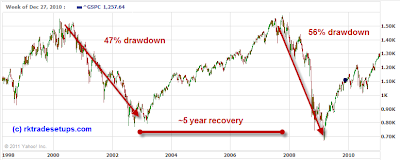
Did everyone hold their portfolios through this downturn? Or did people sell at the worst time because emotions took over?

Did everyone hold their portfolios through this downturn? Or did people sell at the worst time because emotions took over?
Ultimately it comes down to preference and trading style, for me short-term is the way to go!
Wednesday, January 26, 2011
Level II Quotes
Below is an example of simple quotes which are often associated with stock quotations. The bid is what someone is willing to buy the stock at and the ask is what someone is offering to sell their stock at... the difference between them is called a bid-ask spread. The Last column indicates the last price agreement, where stocks were traded, and volume is how many shares have been traded so far.

There are also the bid size and ask size which shows the number of shares (in 100s) at the price shown.... so here the highest price someone is willing to pay for GOOG at the moment is
$617.01 and they have 100 shares to sell. Similarly, someone else (or a collection of people) are willing to buy at $618, there are 200 shares willing to be traded at that price.
The quotes are similar to the car example from yesterday's post, however, here you only see the best prices, but not really what others are willing to pay or offer..... so you don't know who else is buying or selling cars - how many or how much. Below is a Level II quote monitor:

The left column is the bid, the right is the ask. These are all a list of people waiting to buy or sell their stocks at specific prices. You can click on the image to enlarge and see the text better.
So you can see in the bid column, there is someone waiting to buy 100 shares at $617, BUT the next one after that is at $616.58, and someone or collection of people waiting to buy 1100 shares at $616.50. Similarly in the ask side.
This information is very helpful and in a way gives you an in-depth look at what's driving the market... basically a look at supply and demand info!! You can see that all it takes is for someone to be willing to sell 400 shares of GOOG at market for the price to reach $616.55 from the current $617.50 last traded price!! Ever heard of anyone saying that big players can move the market with their orders? That's what it means - if someone all of a sudden dumped a large number of shares, it could drive the price of the stock down, same is true for driving the price up with market buy orders.
BTW, Level II quotes are not free and brokerages usually charge a monthly fee for allowing access to this data.
Why do stocks go up?
Seems like a pretty simple question doesn't it?
It's one of those questions that you hear and figure you know the answer to, but take a moment and try to answer it.... why did Google just go from $640.31 to $641.25 in 3 seconds? Has the value of the company and its products changed somehow in that time period? ..... What's making it move higher?
To the question "why do stock prices rise?" most people answer, "because there are more buyers than sellers so the price goes up!" Well this isn't quite right, there are no more buyers than there are sellers, you need one buyer and one seller to make a transaction, so someone just bought Google at $640.75 and someone else sold it exactly that same price.
To completely understand this, you have to grasp the idea that the stock market is an auction system of buyers (bidding) and sellers (asking) for prices.... hence the bid and ask.
To get a better idea, I will use an analogy I recently read in a book. Let's say you put your BMW up for sale at $50,000, someone comes in and offers you $45,000 for it. You now have a market, a buyer and a seller, but no transaction is taking place because nobody has agreed on a price. You bring down the price to $48,000 and the buyer agrees... now a trade has taken place and the "Last" known price on that BMW is $48,000.... this is how "Last" or "Latest Trade" prices are posted on stocks.
Now, let's expand this. You put the BMW for sale at $50,000, and someone else has put a similar one for sale at $51,000 and someone else at $52,200. The same buyer wants to buy at $45,000. BUT now a hedgefund guy wants to buy his top two sales guys BMWs (which are similar... you know, to avoid jealousy)... he looks into the market and sees three are for sale. He doesn't have time to haggle over a silly couple of thousand dollars, he wants the cars NOW! So, he buys the lower priced $50,000 one, but he still needs another, and there are no more for sale at $50k!! Since he wants the same cars and he wants them now he goes to the other seller and buys the other BMW for $51k. Now the "last" price or "latest traded" price on that specific BMW is $51,000. Market prices went up!
Stocks are the same, there are sellers at certain prices, and they only have a certain number of shares to sell. So more buyers don't necessarily bring up prices, but buyers who want the stock NOW do! They buy the lowest priced stock, when there are no more sellers willing to sell at that price there will be sellers willing to sell at higher prices... if the buyers are willing to pay a little more they buy the shares from the higher sellers too and the price of the stock rises!!
The next post will show more of this with Level II quotes....
Subscribe to:
Posts (Atom)